
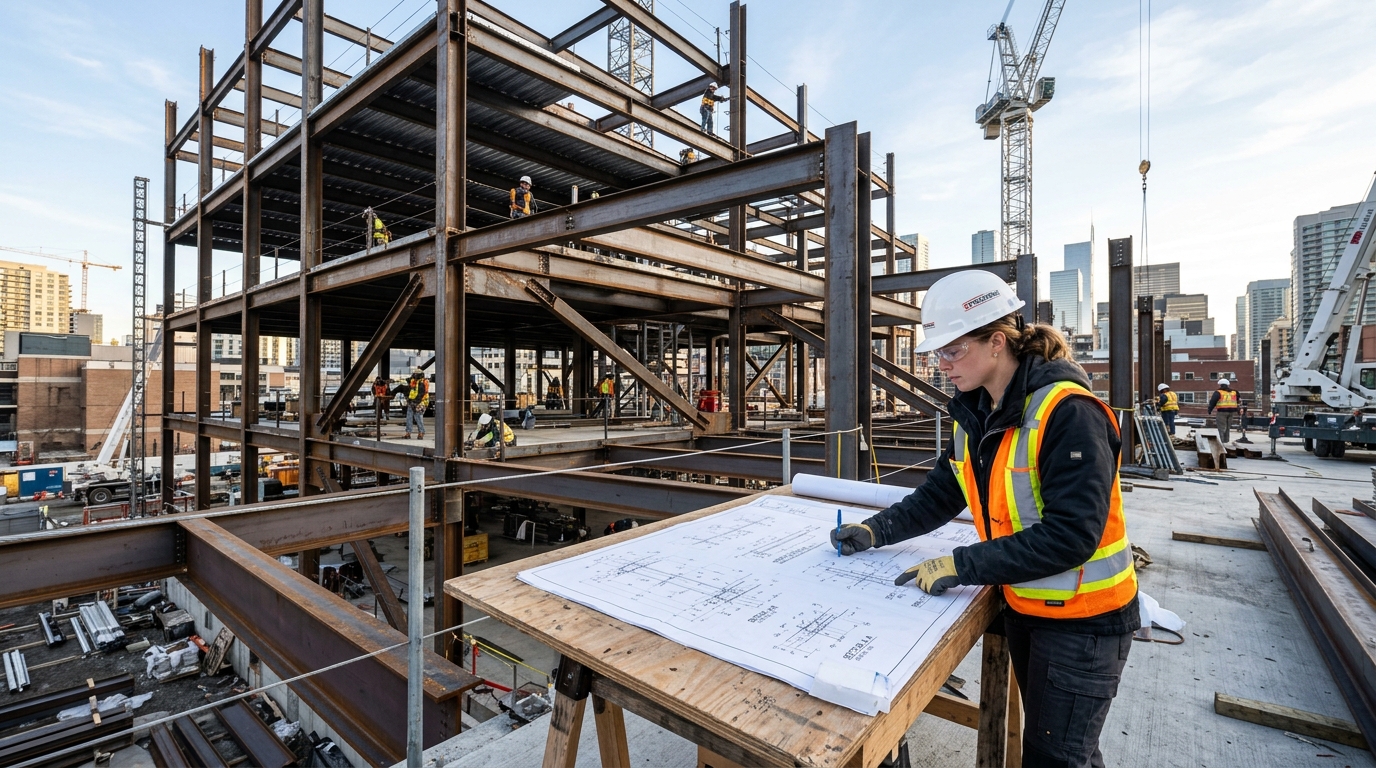
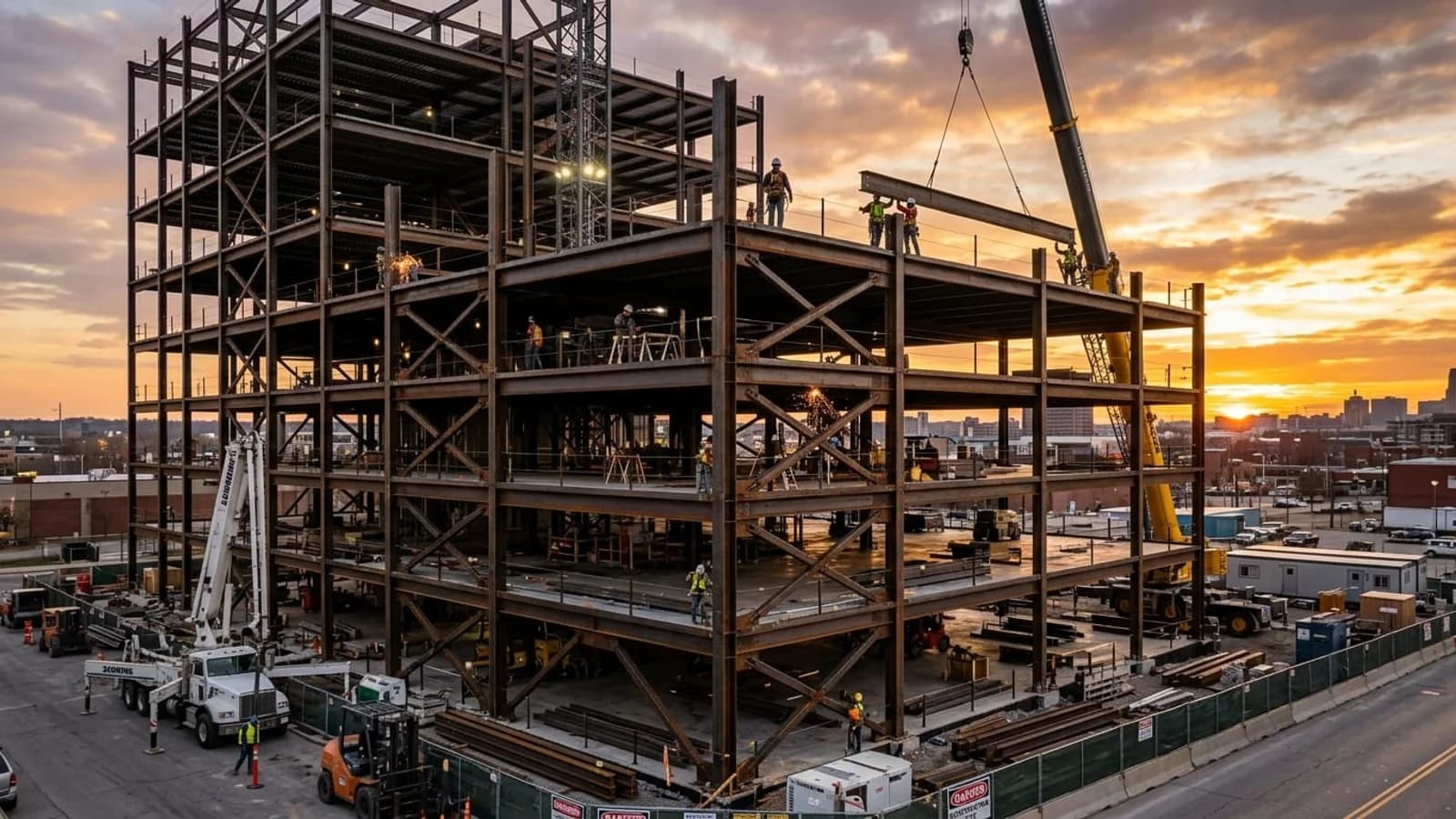
A structural steel shop drawing submittal is the package a fabricator sends to the Engineer of Record for review before any steel is cut, drilled, or welded. When that package is complete, clear, and coordinated, approval comes back fast. When it is not, the same package can loop through revise and resubmit two or three times, and every loop costs shop time, crane time, and schedule confidence.
This guide gives fabricators, general contractors, and detailers a practical checklist for a first review approval. It covers what the Engineer of Record actually checks, what each approval stamp means, the seven reasons packages are most often returned, and what to send with your first submittal so the reviewer never has to guess.
If you are planning a steel package now, start with our structural steel detailing service, where phased submittals, connection detailing, and bills of materials are prepared to AISC standards. You can also review the full range of trades on our shop drawing services page.
What the Engineer of Record Actually Reviews
The Engineer of Record reviews shop drawings for general conformance with the design intent. That is a specific job, and understanding its limits will save you from the most common frustration in steel detailing.
The reviewer checks that member sizes, grades, connections, and framing layout match the contract drawings and specifications. The reviewer checks that loads can travel through the connections you have detailed. The reviewer checks that the package is complete enough for fabrication and erection to proceed safely.
The reviewer does not recheck every dimension, every hole, or every cut length. The reviewer does not take responsibility for the fabricator's means and methods, shop equipment limits, or field fit up. That responsibility stays with the fabricator and the detailer. A stamp that says approved does not mean the package is error free. It means the design intent has been confirmed, and fabrication may proceed on the basis shown.
A package that is technically correct but hard to review will still be delayed. A reviewer who cannot find the anchor bolt plan or trace a piece mark to the bill of materials will return it.
Approval Stamps Explained
Approval stamps vary by firm, but the meanings below cover almost every US project. Read the stamp on your project carefully, because the words control what you may do next.
Stamp | What it means | What you do next |
|---|---|---|
Approved | The package conforms to the design intent as submitted. | Release for fabrication as shown. |
Approved as Noted | The package is approved subject to the corrections written on the drawings. | Make every noted correction, confirm them in writing if required, then fabricate. |
Revise and Resubmit | The package has issues that must be corrected and reviewed again. | Correct every comment, cloud every change, and resubmit the affected sheets. |
Rejected | The package does not conform and cannot proceed in its current form. | Do not fabricate. Resolve the design or scope issue first, then resubmit. |
Approved as Noted is the result most teams should aim for on a first submission. It means the reviewer found only corrections that do not change the design.
The First Review Checklist
Use this checklist before you transmit any steel package. Every item below is something a reviewer, a checker, or a fabricator will look for, often in the first ten minutes of review.
1. Contract documents and revision control
Confirm that every sheet is based on the latest contract set, including the latest addenda, bulletins, and prior RFI answers. List the drawing numbers, dates, and revision numbers you used on the transmittal. If a sheet is based on an older revision, the whole package loses credibility, even if that one sheet is correct.
Keep a single revision block on each sheet. Date every revision. Cloud every change on a resubmittal so the reviewer can see exactly what moved, without rechecking the entire set.
2. Title block, sheet index, and transmittal
Every sheet needs a complete title block: project name, fabricator, detailer, sheet number, scale, date, and revision. The package needs a sheet index that matches the sheets actually transmitted. The transmittal needs a clear list of what is included, what is held for a later phase, and what you need back from the reviewer.
A missing sheet is one of the fastest ways to earn a revise and resubmit. If a sheet is intentionally held, say so on the transmittal. Silence reads as an omission.
3. Member marks, piece marks, and bills of materials
Every member on an erection plan must trace to a shop drawing, and every shop drawing must trace to a bill of materials. Piece marks must be consistent across plans, assemblies, single part drawings, and the bill of materials. A mark that appears on a plan but not in the bill, or in the bill but not on any drawing, will stop a review.
Include member sizes, grades, lengths, weights, and finishes in the bill of materials. For wide flange shapes, hollow structural sections, channels, and angles, state the ASTM grade clearly, for example ASTM A992 for wide flange members and ASTM A36 for plates and bars where specified. Advance bills help mills and procurement teams order steel while the full package is still under review, but only if the marks on the advance bill match the marks that will appear on the final drawings.
4. Connections, bolts, and welds
Connections are where most steel submittals fail. Show every connection type used: single plate shear tabs, double clip angles, seated connections, moment connections, bracing gussets, column splices, and base plates. Show bolt diameter, grade, spacing, edge distance, and hole type. State whether each joint is snug tight, pretensioned, or slip critical, following the RCSC Specification for Structural Joints.
Show welds with AWS D1.1 symbols, not with notes alone. State weld size, type, length, and whether each weld is shop or field. Show weld access holes, backing bars, and continuity plates where they apply. If a connection reaction is missing from the contract documents, do not guess it. Submit an RFI and hold that connection until the answer arrives. A guessed connection that later changes will cost far more than a short RFI delay.
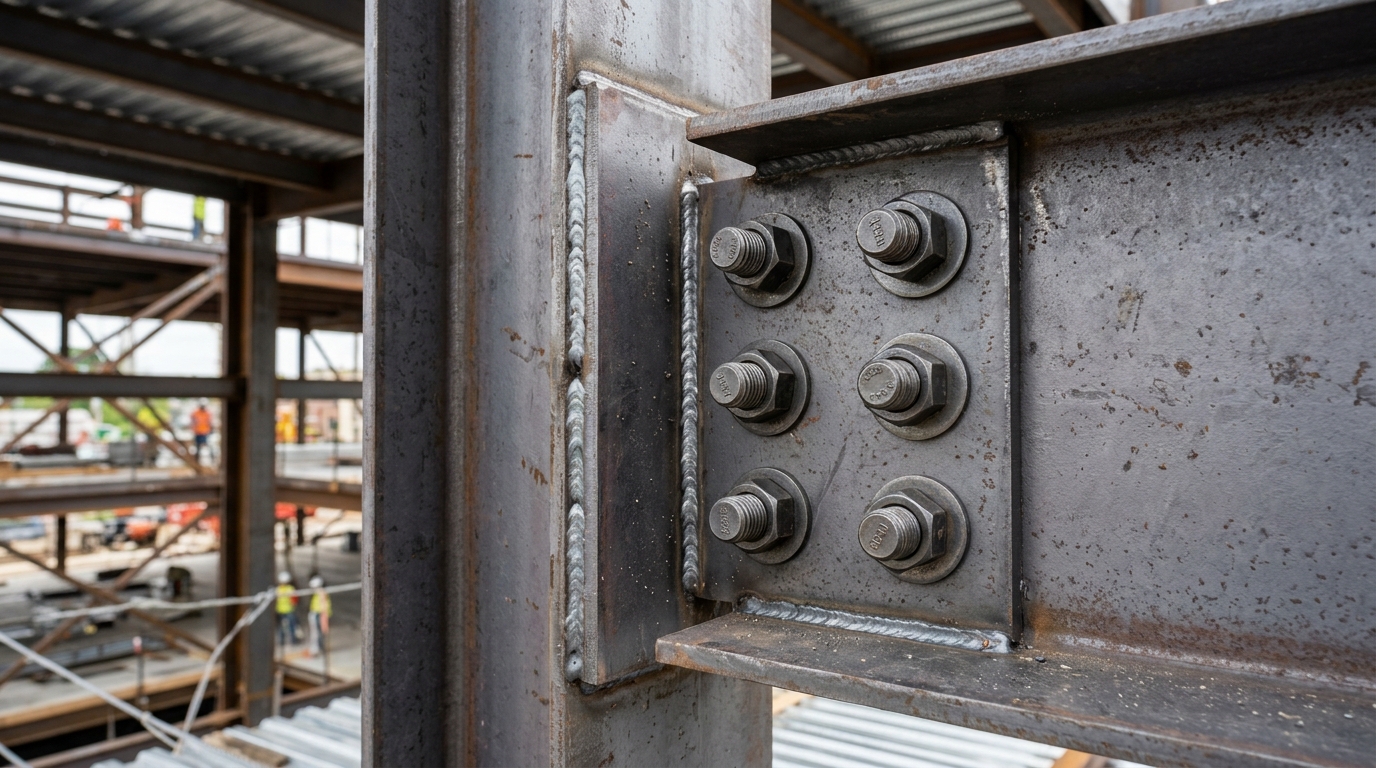
Structural steel bolted connection detail with plates and welds
5. Anchor bolts, base plates, and embeds
Anchor bolt setting plans must be submitted early, because concrete work cannot wait for the full steel package. Show anchor rod diameter, grade, embedment, projection, template dimensions, and base plate hole patterns. Cross reference the foundation drawings directly, and flag any conflict between the steel base plate layout and the concrete pier layout before the pour.
Include leveling plate, grout pocket, and shim details where required. A base plate that cannot be leveled and grouted cleanly in the field will create problems that no later shop drawing can fix.
6. Erection plan, gridlines, and sequencing
Erection plans must show column gridlines, floor elevations, top of steel elevations, member marks, field bolt schedules, and shake out staging. Show temporary bracing, lifting points, and the erection sequence by tier or bay where the project requires it. Ironworkers and crane operators should be able to read the sequence from the plan without calling the detailer for clarification.
Check clearances that are easy to miss on a plan but expensive in the field: stair headroom, duct and pipe penetrations through beams, deck bearing, and fireproofing thickness where it changes a connection or a clearance.
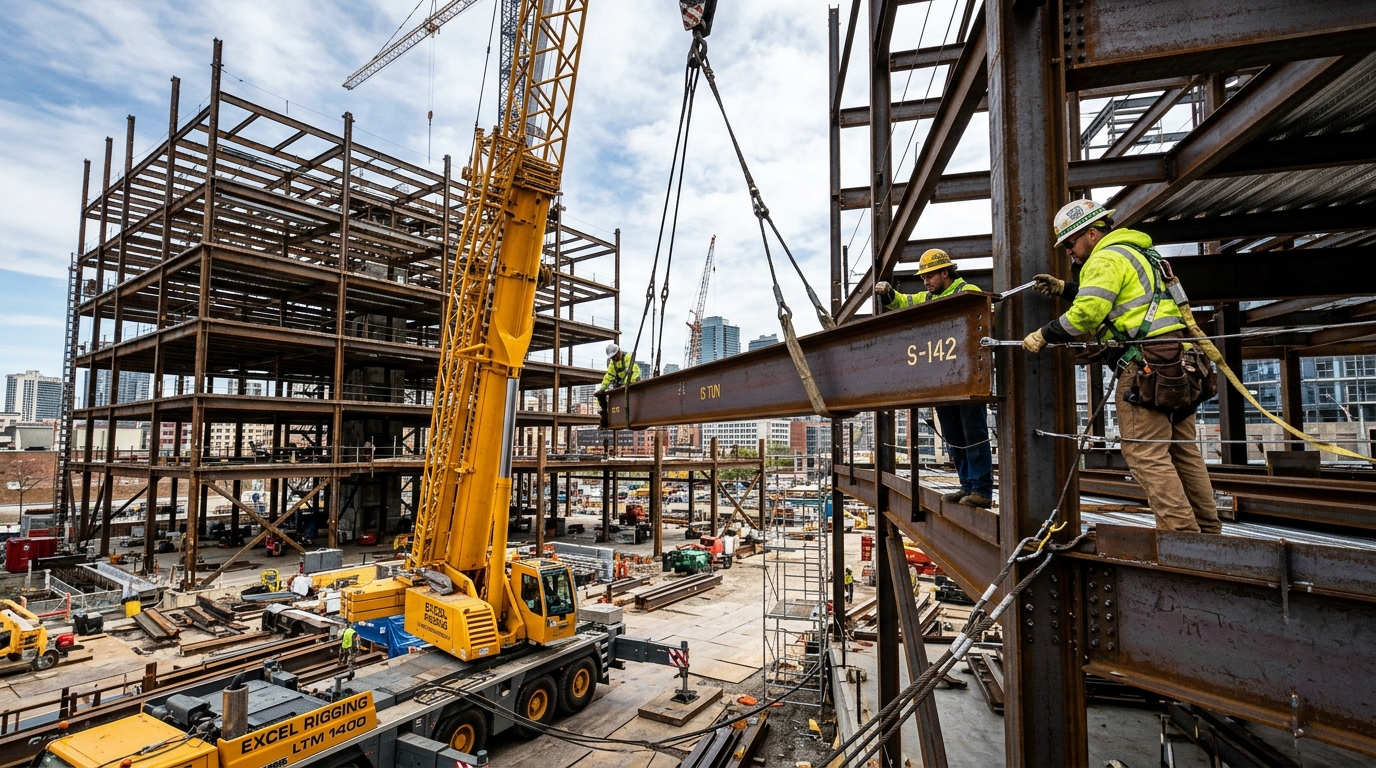
Steel erection site with crane lifting a beam into a multi storey frame
7. Dimensions and tolerances
Follow ANSI/AISC 303, the Code of Standard Practice for Steel Buildings and Bridges, for submittal, approval, fabrication, and erection tolerances. Fabrication dimensions on shop drawings are commonly held to tight tolerances, and the steel detailing service page for this site notes 1/16 inch fabrication tolerances under AISC 303 Section 6. Do not rely on that number as a substitute for the project specification. Read the specification for your project and state the governing tolerance on the drawings where it matters.
Check grid to grid dimensions, column centerlines, floor to floor heights, and camber direction and magnitude. A camber shown in the wrong direction, or a splice elevation that does not match the column schedule, will be caught in review if you are lucky, and in the field if you are not.
8. Coordination with other trades
Steel does not stand alone. Check mechanical penetrations, electrical conduit, plumbing, curtain wall anchors, stair and railing supports, and deck openings against the structural framing before you submit. A beam that blocks a duct run, a brace that lands on a door opening, or a base plate that conflicts with a floor drain will all return as review comments, and each one is cheaper to fix in the model than in the shop.
Where multi trade coordination is part of the scope, use a federated model review and record the clash resolutions in the submittal notes. Reviewers trust a package more when coordination is visible, not just claimed.
9. File formats and legibility
Submit bookmarked vector PDF sheets with a clear sheet index, plus native DWG files where the contract requires them. For steel packages, include Tekla model exports and CNC DSTV data where the fabricator's shop equipment uses them. Keep layer standards clean, keep text legible at the printed sheet size, and keep line weights consistent. A drawing that cannot be read at ARCH D size will not be approved at any size.
Before you transmit, print or view every sheet at full size. Check for clipped text, overlapping dimensions, missing weld symbols, and title blocks that run off the sheet. These are small errors, but they signal to a reviewer that the package was not checked.
Seven Reasons Packages Are Returned, and How to Fix Each One
Outdated contract documents. Fix: lock a document set for each phase, list it on the transmittal, and recheck it on every resubmittal.
Missing or inconsistent piece marks. Fix: run a mark to bill of materials cross check before transmission, and never reuse a mark for a different member.
Connection reactions not shown or not followed. Fix: follow the reaction schedule exactly, and RFI anything missing before detailing that connection.
Weld and bolt information incomplete. Fix: show size, type, length, shop or field status, and hole type on every connection, not in a general note alone.
Anchor bolt plan submitted too late or incomplete. Fix: phase the submittal. Send anchor bolts and embeds first, then tiers and assemblies.
Uncoordinated penetrations and clearances. Fix: coordinate MEP, stairs, deck, and facade anchors in the model, and note the resolutions.
Revision changes not clouded. Fix: cloud every change, update the revision block, and list the changed sheets on the resubmittal transmittal.
What a Good RFI Looks Like
A good RFI is short, specific, and easy to answer. It states the problem, shows the location, and proposes a solution or asks for one clear decision.
Example: "At gridline C, level 2, beam B24 connects to column C12 with a moment connection. The contract drawings do not list a moment reaction for this joint. Please confirm the design moment and shear, or confirm that a standard shear connection may be used. Detail is held pending your answer."
That RFI can be answered in one sentence. A vague RFI, such as "please clarify connections at level 2", cannot, and it will sit unanswered while the schedule moves on.
How Long Does Steel Submittal Approval Take
Approval time depends on package size, reviewer workload, and how complete the first submission is. Small phased packages often move faster than one massive package, because the reviewer can approve anchor bolts and tier one steel while later tiers are still being detailed. That is why phased submittals are now standard practice on commercial steel work.
On this site, phased structural steel submittals are prepared on a 3 to 7 business day milestone basis to support foundation pours and shop fabrication milestones. The exact turnaround for your project depends on sheet count, connection complexity, and how quickly RFI answers come back, and it should be confirmed in writing at the proposal stage, not assumed from a marketing page.
If your project is still at the bidding stage and you need quantities and pricing before detailing starts, that is a different scope. In that case , aconstruction estimating service can establish the material quantities and cost picture first, so the detailing scope and the budget are agreed before shop drawings begin. Once quantities are settled, the detailing team can work from a stable scope instead of a moving target.
What to Send for a Fixed Proposal
A fixed proposal needs the same documents a reviewer needs, because the detailer cannot price what cannot be seen. Send the structural drawings, architectural drawings for edge clearances and openings, project specifications for Division 05 metals, connection criteria or reaction tables, current addenda, and your fabricator shop standards for hole sizes, bolt diameters, and maximum shipping lengths. State your phasing needs and your milestone dates.
Our detailing process follows four steps: send plans and specifications, scope review and fixed proposal, drafting and coordination, then submittal delivery and support. That sequence exists so that price, delivery dates, and scope are agreed before drafting starts, not discovered halfway through it.
When you are ready, send your drawings through our contact and quote page. Include the project schedule and any fabricator standards you follow, and the team will review dimensions, quantify sheet requirements, and return an itemized proposal with delivery dates.
Frequently Asked Questions
Does EOR approval mean the fabricator is no longer responsible for dimensions?
No. EOR approval confirms general conformance with the design intent. The fabricator and detailer remain responsible for dimensions, fit up, and shop accuracy under AISC 303.
Can steel be fabricated before approval?
As a general rule, no. Fabricating before approval risks rework if the reviewer requires a change. Anchor bolt templates and advance procurement are common exceptions, and they should be agreed in writing.
What should be submitted first on a steel project?
Anchor bolt and embed plans first, because concrete work depends on them. Then erection plans and assemblies by tier, so fabrication and erection can proceed in sequence.
How do I handle a connection with no reaction in the contract documents?
Do not guess. Submit a short, specific RFI with the gridline, member marks, and a proposed solution, and hold that connection until the answer is received.
Final Check Before You Transmit
Before you send any steel package, run this five minute check. Is the document set current? Does every piece mark trace to a drawing and a bill of materials? Are all connections, bolts, and welds fully shown? Is the anchor bolt plan included or clearly phased? Are all resubmittal changes clouded? If you can answer yes to all five, your package is ready for a first review. If you cannot, fix it now. The reviewer will find it anyway, and finding it in your own office is always cheaper than finding it in a revise and resubmit letter.